KAIYI / AUTOMOTIVE · DEALERS · CUSTOMER EXPERIENCE

Kaiyi: connecting vehicle trust, test drives and dealer experience

Russian automotive research: 50 in-depth interviews, 60 dealer audits across 20 cities and a survey of 3,000 car owners. Russia · 2025.

Russia · Automotive market · 2025Project value
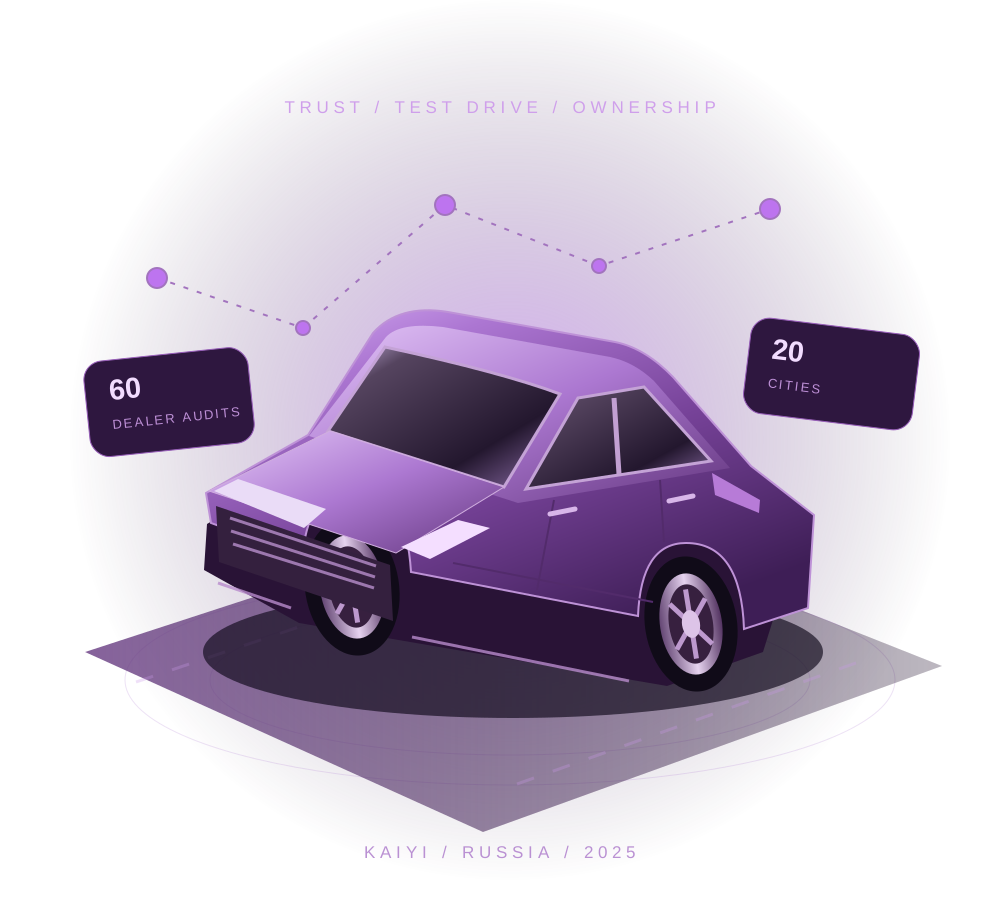
Conceptual dimensional illustration of a vehicle and dealer network
50in-depth interviews
60dealer centres
20Russian cities
3,000survey participants
01 / CONTEXT

A locally produced car still needs to earn long-term trust

Russia, 2025

The project examined consumer behaviour, dealer performance and Kaiyi brand perceptions in Russia, focusing on the Central, Northwestern, Volga, Southern and Ural federal districts. Its purpose was to connect product adaptation, the sales experience and aftersales service.

Local production as a starting point

Production of the E5, X3, X3 Pro and X7 Kunlun at Avtotor in the Kaliningrad region formed the local manufacturing context. Buyers still needed to understand winter usability, maintenance, ownership costs and the practical experience of a warranty repair.

A crowded consideration set

The supplied brief compared Changan, Chery, Haval, Geely, Omoda and BAIC alongside familiar used-car alternatives. Its RUB 2.0–3.2 million price range is historical project context, not a current price list. Price competed with familiarity, equipment and perceived ownership risk.

Trust extends beyond the transaction

Concerns included corrosion, parts availability, electronics in cold weather and resale value. The study therefore looked beyond the first sale: advice in the showroom needed to align with everyday ownership and accessible aftersales support.

An uneven dealer experience

Customers experience the brand and the local dealer as one system, even when communication, demonstrations and deal calculations vary. The project sought the points where local processes strengthened or undermined the brand promise.
02 / OBJECTIVES

From the first comparison to purchase and the first ownership year

Map the customer journey

Examine research, model comparison, dealer contact, showroom visits, test drives, finance or trade-in, handover and servicing. Each transition required an understanding of the customer’s questions, evidence needs and reasons for withdrawal.

Identify switching barriers

Compare owners with people who considered Kaiyi but chose a competitor. This contrast distinguishes general caution about a new brand from specific product, financing or dealer-experience objections.

Prioritise equipment

Explore ground clearance, noise insulation, climate systems, heating, infotainment and ergonomics. Distinguish features seen as basic usability requirements from extras that support preference.

Assess dealer sales quality

Check the ability to explain equipment, offer a meaningful test drive and present understandable finance and trade-in calculations. Transparency of additional services and consistency between initial offers and showroom discussions were central.

Connect retail and fleet strategy

Explore the E5’s fleet, taxi and car-sharing potential through ownership costs and predictable service. Fleet use was also considered as an opportunity for private customers to encounter the brand in everyday travel.

03 / METHODOLOGY

Connect customer accounts, dealer visits and ownership data

50 in-depth interviews

Participants included E5, X3 and X7 Kunlun owners who had bought within the preceding 6–12 months, and motorists who considered the brand but bought a competitor. Interviews explored expectations, choice and subsequent ownership experience.

60 dealers across 20 cities

Mystery Test-Drive combined mystery shopping with sales and service auditing. It examined vehicle presentation, test-drive delivery, trade-in calculations and consultation quality. Sixty refers to dealerships covered; repeat-visit counts are not specified.

3,000 car owners / CAWI

The survey covered motorists who had replaced their vehicle within the preceding 18 months. It compared decision criteria, concerns and offer perceptions. Detailed quotas, recruitment and weighting are not disclosed, so this case does not independently assert national representativeness.

Equipment conjoint analysis

Trade-offs included AWD, heating, screen size, corrosion protection and ADAS at different price points. The objective was to evaluate combinations with price rather than collect unconstrained feature wishes. A separate sample size and utility coefficients are not supplied.

Additional research streams

The framework included Focus Labs, telemetry and service-log analytics to connect perceptions with ownership experience. Separate focus-group counts, telemetry volumes and service-log periods are not supplied.

An integrated interpretation

Interviews explained choice, audits examined delivery, CAWI compared preferences and conjoint explored equipment trade-offs. These streams addressed different questions and were not combined into one participant count.

04 / CUSTOMER JOURNEY

Seven points where the brand earns or loses trust

01 / Search and shortlist

Buyers set a budget and body type, read reviews and compare equipment and used-car alternatives. Clear model positioning and relevant ownership evidence help them assess suitability.

02 / First dealer contact

Availability, equipment, final price and test-drive arrangements turn advertising into a concrete offer. Unclear information increases uncertainty before the showroom visit.

03 / Vehicle introduction

Seating, visibility, materials, interfaces and luggage space make expectations tangible. Demonstrations need to connect features with winter starts, family trips, uneven roads and regular urban driving.

04 / A meaningful test drive

A suitable route helps customers experience dynamics, suspension, handling and acoustic comfort. The extended format provides personal evidence of suitability within safe, permitted driving conditions.

05 / Finance and trade-in

Customers compare their old car’s valuation, down payment, monthly payment and additional services. A clear breakdown makes alternatives and changes to the total understandable.

06 / Handover and early ownership

Infotainment setup, servicing information and real journeys test the purchase promise. Winter-feature and usability expectations need to hold up in everyday driving.

07 / Service, warranty and future choice

Booking, parts availability and clear warranty procedures shape brand perception. Predictable support can sustain trust and future consideration. Stage-by-stage conversion figures are not published.

05 / INSIGHTS

Four findings about buying and owning

01 / Test drives reduce scepticism

The source reports that more than 68% of potential customers completing a full test drive shifted their opinion towards purchase. This is an attitude change within that group, not a claim that 68% of visitors bought a car. Short showroom loops offered less opportunity to evaluate the driving experience.

02 / Winter usability outweighs decorative extras

For 82% of regional buyers in the supplied findings, comprehensive heating and corrosion protection mattered more than a panoramic roof or ambient lighting. Winter suitability was a core value consideration. The precise subgroup denominator is not specified.

03 / Opaque calculations undermine purchase readiness

The source attributes losses of up to 35% of purchase-ready customers at the trade-in and financing stage to opaque insurance additions and unsatisfactory used-car valuations. This concerns the described dealer funnel, not the entire market.

04 / Fleets make the brand visible

The E5 was identified as a fleet, taxi and car-sharing opportunity through ownership costs and service experience. The “mass test-drive” idea describes passenger exposure to the vehicle; its effect on private sales was not separately quantified.

06 / SOLUTIONS

Align product, dealers and aftersales support

Product / winter suitability

Recommendations focused on base and mid-level equipment with a comprehensive winter package. The material describes specification adaptation at Avtotor, corrosion-protection improvements and Russian-language infotainment. These are project directions, not a statement that every produced car contains every feature.

Retail / an extended test-drive route

Extended City & Rough Road Test-Drive was designed as a meaningful demonstration instead of a routine short loop. The approach linked route stages with customer questions about comfort, dynamics, handling and available assistance systems.

Transaction / understandable calculations

Trade-in and finance findings informed clearer separation of valuation, finance terms and added services. This elaborates the identified problem; the source does not report a separate measured rollout of a standard calculation form.

B2B / predictable fleet economics

The source describes Kaiyi Corporate Fleet with a defined maintenance-cost schedule and corporate support. Planning costs, arranging service and obtaining parts frame the car as an operational asset.

Service / clear warranty communication

Recommendations included central parts-stock development and clearer explanation of the programme described as five years or 150,000 km. This is historical project context; coverage depends on the vehicle and service documents, not a universal promise for every use case.

Digital experience / service history

The material describes an app for service booking and maintenance history. Its purpose was to reduce post-purchase uncertainty and simplify interaction. User counts, adoption and the app’s individual contribution to trust are not disclosed.

07 / OUTCOMES

Changes reported in the project materials

+24% / product satisfaction

The case associates CSAT growth with product and equipment adaptation. This is reported as relative change, not 24 percentage points. The baseline, index formula and comparison period are not supplied.

+19% / test-drive-to-sale conversion

The reported increase relates to the revised demonstration format and the test-drive-to-sale transition. It is not total dealer revenue growth. Starting and final conversion levels are not specified.

32% / B2B share of sales

This is the reported reached share of corporate sales, not a 32% increase. It relates to fleet development. The starting share, measurement period and unit volumes are not provided.

+28 points / brand trust

The change concerns Brand Trust Index and is associated with warranty and service initiatives. It is an index-point change, not a percentage or NPS score. Scale construction is not disclosed.

Reading the outcomes

All figures follow the supplied case material. Causal evaluation design and component-level effects are not published. They describe this project’s reported outcomes rather than guaranteeing similar performance elsewhere.

08 / PROJECT VALUE

From isolated improvements to a coherent brand experience

For product teams

The research connected equipment expectations with ownership circumstances, framing heating, body protection and interfaces through driver value rather than specification lists alone.

For the dealer network

The study provided a basis for aligning presentation, test drives and financial explanations so that a positive vehicle experience was not undermined by uncertainty around the transaction.

For brand and distribution

Retail, fleets and aftersales were treated as connected areas. Local production becomes meaningful to customers when the product, dealer and service experience consistently support the same promise.

AUTOMOTIVE / RESEARCH / CUSTOMER EXPERIENCE

Need to connect research with business decisions?

Explore customer choice, purchase barriers and ownership experience. Connect findings with product, sales and service decisions.

LET’S START WITH YOUR CHALLENGE

Discuss your project

Tell us what you need to learn, and we’ll suggest the right research approach.

Select all services you’re interested in
$
$0$30,000

We will contact you about your project.