CLOSET LONDON / FASHION · FIT · INTERNATIONAL D2C

Closet London: from an occasion dress to an international D2C wardrobe

Wardrobe and international returns research: 60 video-diary participants, 40 wardrobe audits and a survey of 3,200 women. UK, EU and US · 2025.

UK · EU · US · 2025Project value
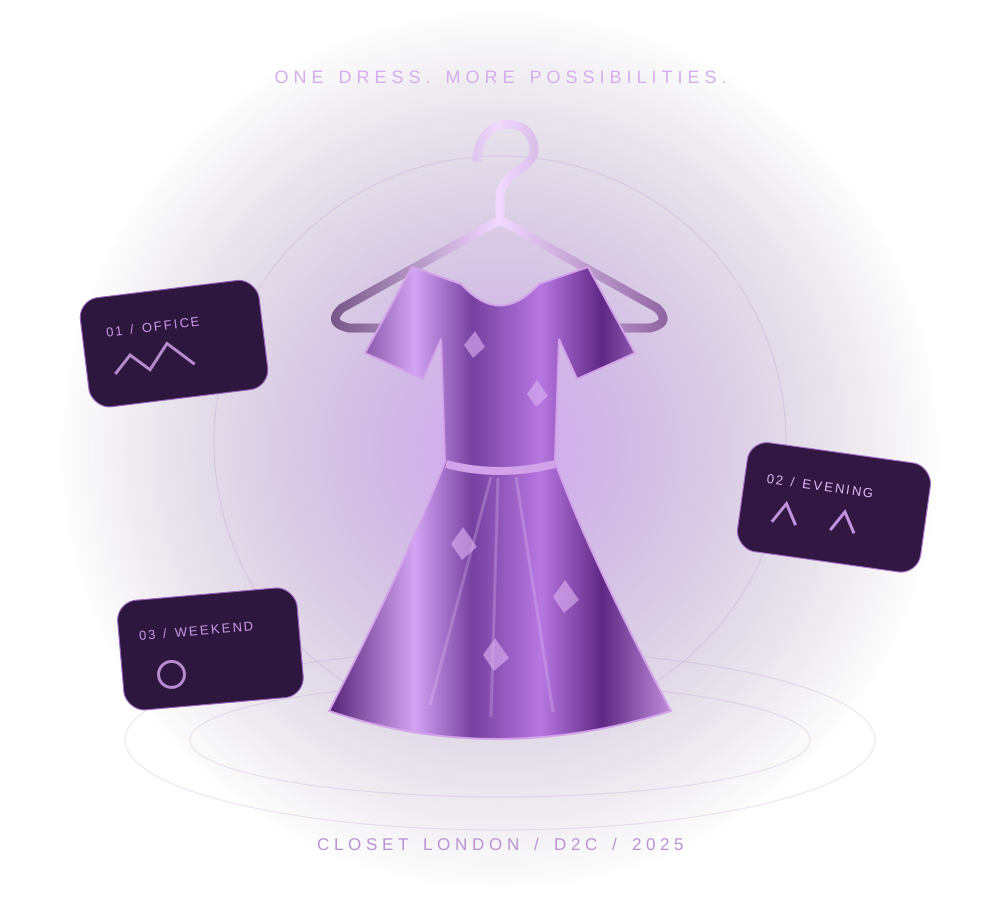
Dimensional dress illustration with three styling occasions
60video-diary participants
40wardrobe audits
3,200survey participants
18months of transaction data
01 / CONTEXT

Feminine style beyond a single occasion

London design as a foundation

Since 1996, Closet London has developed feminine shapes, signature prints and a Desk-to-Dinner proposition. London design and connections with local production formed an important part of its provenance and quality story.

Occasionwear changes its job

Customers wanted expressive clothes to work across situations. A dress bought for a wedding or party needed a role afterwards, making future styling part of the purchase proposition.

Direct retail alongside multi-brand platforms

ASOS, Next, Zalando and fast fashion provided familiar shopping and price comparisons. D2C needed its own value through fit information, fabric presentation, styling and product provenance.

Growth includes home fitting

International buying moves much of the decision into a customer’s home. Size information, fabric expectations and silhouette confidence influence whether a product stays, connecting sales growth with returns.

Year and geography

The 2025 project covered the UK, Ireland, Germany and the US. Method coverage differed: video diaries are described for the UK, Germany and US, while the survey uses UK, EU and US groups.
02 / OBJECTIVES

Connect wardrobe use, fit and direct sales

Explore occasion-to-everyday use

Understand how printed dresses are styled after their first event and which features make them versatile while retaining a feminine, expressive identity.

Explain international returns

Examine size, bust, waist, armhole, fabric, colour and movement, distinguishing product construction from information gaps in a product page.

Assess provenance value

Explore the relevance of London design and manufacturing history and where credible evidence can help the customer choose.

Improve D2C experience

Identify reasons for leaving the brand site for familiar platforms, considering imagery, size guidance and multiple-use styling.

Connect assortment with repeat use

Explore how jackets, cover-ups and coordinated categories complement dresses and extend an existing wardrobe.

03 / METHODS

Clothes on screen, in movement and in wardrobes

60 participants / unboxing and fitting videos

Women in the UK, Germany and US recorded unpacking and trying on dresses. Fabric, colour accuracy and movement comfort showed the moment online expectations met personal experience.

40 digital wardrobe audits

In-depth wardrobe interviews compared single-event dresses with regularly worn pieces, exploring actual combinations and reasons an expressive item returns to everyday rotation.

3,200 participants / CAWI

The survey considered UK, EU and US geography, style preferences and wardrobe budgets. Selection, country quotas and weighting are not disclosed, and the sample is not combined with other research streams.

18 months / returns data

Anonymised transactions and returns were analysed by category, silhouette and delivery country. Exact calendar boundaries and transaction counts are not supplied.

Conjoint / price, fabric and origin

The overall framework includes conjoint analysis of combined offer attributes. Utility estimates and a separate sample size are not provided.

Connecting the methods

Videos captured fitting reactions, wardrobe interviews later use, the survey broader preferences and transaction analysis return patterns. Together these connected product, content and international experience.

04 / CUSTOMER JOURNEY

From a reason to buy to a reason to wear again

01 / Occasion and inspiration

A customer looks for an expressive item for an event. Print and shape matter alongside the question of whether the dress will work afterwards.

02 / Product page and size

Before paying, she needs to imagine colour, texture and fit on her own body. Static photography and a familiar size name may leave uncertainty in an international order.

03 / Unboxing and movement

Touch, ordinary light, walking and arm movement reveal how the item differs from a screen-based expectation.

04 / Keep or return

Comfort, expectations and styling possibilities combine in the decision. Analysis connects return reasons with both pattern changes and product explanations.

05 / New looks and another purchase

A dress gains value when it works with existing jackets, trainers or boots. Further purchases can complement that system. This journey elaborates the supplied research logic without adding measured stage conversions.

05 / INTERNATIONAL EXPERIENCE

One product, different uncertainties

UK / the starting fit logic

British fit was the product reference point. The research compared it with other markets’ expectations while considering the original style proposition.

US / bust and waist

The source describes some American customers perceiving dresses as small around bust and waist, raising questions about patterns, fit descriptions and international size mapping.

Germany / armhole and movement

Reported armhole stiffness illustrated why length and a standard table may be insufficient. Video movement added context to measurements.

Ireland and the European scope

Ireland appears in the overall project geography. No separate country figures are supplied, so the case does not assign identical reactions to every European market.

06 / INSIGHTS

Four reasons to change product and content

01 / Single-occasion fatigue

More than 67% of respondents in the supplied findings expressed interest in shapes wearable afterwards with boots, an oversized jacket or trainers. The exact denominator is not specified. The insight connects expression with repeat use.

02 / Fit accounted for a significant return category

The source attributes up to 40% of returns from the US and Germany to UK-fit issues. This concerns reasons within those returns, not a claim that 40% of all orders were returned.

03 / Prints prompted first purchases

Signature prints differentiated the brand, but natural-light and movement imagery was limited. Customers needed to see how a print behaved on a real silhouette.

04 / The London story was hard to see

Design and production provenance were insufficiently visible at first choice. The research linked stronger communication with credible craft evidence beyond a label alone.

07 / SOLUTIONS

Four transformation directions

Flexi-Fit / product and sizing

Recommendations included adapted patterns, discreet elastic, adjustable belts and clearer international tables. The source describes a Flexi-Fit launch and sizing-information updates to support comfort while retaining the silhouette.

1 Item — 3 Looks / styling

Product pages would show office, evening and weekend uses. The case describes styling videos and UGC to help customers imagine a dress within their own wardrobe before ordering.

Designed & Crafted in London / brand story

The direction strengthened production storytelling through communication, packaging and atelier QR material. Provenance connected design, craft and quality; it concerns brand history and relevant products rather than a blanket claim about every current garment’s origin.

Closet Mix & Match / assortment

The source describes coordinated jackets, cover-ups and trouser suits alongside dresses, creating complementary looks and extensions of an existing wardrobe.

08 / OUTCOMES

Changes reported in the project materials

−24% / returns from the US and EU

The case links reduced returns with fit and sizing. The figure is a relative change, not a 24 percentage-point reduction. Baseline and comparison dates are not disclosed.

+31% / D2C conversion

The source reports increased conversion alongside styling and content improvements. It is relative growth, not 31 percentage points. Final conversion and component-specific effects are not provided.

+18 points / US customer NPS

The NPS change is in index points and relates in the case to stronger brand and production storytelling. Response counts and measurement dates are not supplied.

+22% / average order value

AOV refers to average order value in the Mix & Match direction, not 22% more orders. Detailed basket composition and category-attribution methods are not disclosed.

Interpreting the outcomes

All four changes follow the supplied materials. Causal evaluation design is not published. They describe reported outcomes in this case and are not guarantees for another business.

09 / PROJECT VALUE

From a single occasion to a wardrobe system

For product

Research connected construction and sizing with real fitting and movement, providing a basis for specific international adaptations.

For D2C and content

Print, fabric, multiple looks and provenance formed a connected product explanation. The brand site could support choice beyond a simple model listing.

For assortment and scale

Coordinated capsules extended dress use, while market-specific analysis acknowledged international differences. The practical value was alignment between product, content and wardrobe relevance.

BRAND / RETAIL / CUSTOMER EXPERIENCE

Need to connect research with business decisions?

Let’s explore customer choice, brand perceptions and development opportunities for your assortment and retail experience.

LET’S START WITH YOUR CHALLENGE

Discuss your project

Tell us what you need to learn, and we’ll suggest the right research approach.

Select all services you’re interested in
$
$0$30,000

We will contact you about your project.